Seven Great Mentors receive the Department of Chemistry Mentorship Spotlight Award
The winners were nominated by students, postdocs, faculty, and staff in recognition of their exceptional commitment to mentorship.
Seven members of the Department of Chemistry community have been honored with the department’s semi-annual Mentorship Spotlight Award. Established in 2020, the award recognizes individuals who demonstrate exceptional commitment to fostering a positive working environment, leading by example, and providing outstanding mentorship to their peers and mentees. Each recipient receives a crystal award and a monetary prize.
Spring 2026 Mentorship Spotlight Awardees
Rad Chrzanowski
Rad Chrzanowski, a graduate student, was celebrated for his sage advice, ability to balance serious topics while maintaining a personable approach, and overall commitment to providing quality mentorship to all members in Professor Mohammad Movassaghi‘s group, particularly younger graduate students and a UROP student, all while serving as the group’s Environment, Health, and Safety (EHS) Representative.
As one mentee noted: “Rad fosters a space where all questions are encouraged, promoting curiosity and enabling lasting understanding. He is incredibly patient, treating every question with respect and normalizing confusion as a natural part of the learning process. He leads by example, setting a high standard through his strong skill set, work ethic, and attention to detail. When experiments fail or results are unclear, Rad’s encouragement provides the motivation to persevere. He consistently frames mistakes as opportunities for growth rather than roadblocks, and he thoughtfully engages with research questions to foster scientific discussions.”
Reflecting on his own journey, Rad shared, “As someone coming from a family with little science background, I’ve found that the mentorship I’ve received through my academic career was a critical component in my development of my love for chemistry and the practical skills that have gotten me to where I am today. It is a joy to me to see others find excitement in the work that we perform, and I find it essential to support younger chemists as they explore the field, just as I had been supported through undergrad and grad school.”
Rad’s research with the Movassaghi Lab primarily focuses on the total synthesis of epidithiodiketopiperazine (ETP) natural products and their derivatives.
Dr. Jesús Castro Esteban
Postdoctoral Researcher Jesús Castro Esteban was honored for his commitment to the scientific, professional, and personal development of others, his unwavering support, and his deliberate efforts to mentor fellow members of Professor Timothy Manning Swager‘s lab. As one mentee wrote: “Jesús took on the role of my postdoctoral mentor when I joined the Swager Lab and has been a guiding light for me ever since. Over the past year and a half, he has taught me countless experimental techniques and gone above and beyond to share his scientific expertise. He is incredibly patient and endlessly encouraging, no matter how many questions I ask or Slack messages I send.”
“I am motivated to mentor because I value creating a supportive environment where others can learn and succeed,” said Jesús. “Seeing students grow scientifically and personally while developing confidence in the laboratory is especially rewarding to me.”
Jesús’ research combines organic chemistry and materials science to develop functional porous organic polymers for heterogeneous catalysis, gas separation, and sensing applications.
Wenlai Han
Wenlai Han, a graduate student, was recognized for his egoless and fundamental respect for the strengths of others, his compassionate leadership, his sincere desire to help others, and his uncanny ability to uplift fellow members of Professor Alison Wendlandt‘s lab, both scientifically and emotionally. One nominator wrote: “Wenlai’s mentorship has made my transition into the PhD program here a relatively smooth journey… His combination of technical rigor, genuine care for mentee development, and commitment to building a supportive laboratory environment makes him an outstanding mentor.” Said another: “Wenlai has been highly effective at distributing project components to build ON the strengths of his coworkers, as well as to build UP the strengths of his coworkers. In this way, Wenlai shows that humility and human-centered leadership are accelerants, not obstacles, to scientific excellence.”
“My motivation stems from fostering an environment where mentees feel empowered to find their own voice and independence,” said Wenlai. “I feel grateful to experience the dynamic shift between listening and leading to help others navigate their own growth.”
Wenlai’s research in the Wendlandt Lab focuses on carbon skeleton remodeling and rescaffolding via controlling dynamic kinetic networks. Alongside his doctoral work, he serves as the lab’s EHS representative and engages in various community outreach events.
Ira Martyniak
Graduate student Ira Martyniak was honored for her boundless emotional and professional support, her deep empathy and thoughtful explanations, and her consistent efforts to patiently and encouragingly mentor others—even those outside of Professor Danna Freedman‘s lab. One of Ira’s mentees said in their nomination: “Ira’s mentorship style is a perfect balance of hands-on guidance and encouraging independence. She diligently demonstrates best practices in the lab, helping her mentees understand not just how but why, and building their skills so they can develop their own techniques and research questions. She is a dedicated and passionate mentor. She is thorough, patient, and deeply invested in her mentees’ success. She is deeply caring and will go out of her way to offer time and help to those around her.”
“I feel incredibly privileged and fortunate to have been mentored by some of the world’s greatest scientists who happen to be the most empathetic and thoughtful human beings at the same time,” said Ira. “Therefore, my motivation to mentor stems from the desire to recreate that environment of growth and confidence for others, ensuring my mentees have the tools and support to navigate their own paths independently.”
In the Freedman Lab, Ira investigates how relativistic effects influence the chemistry of heavy metals, such as the 5d and 6p elements. By conducting chemical reactions between these metals in conditions of extreme pressures and temperatures, she synthesizes new metastable intermetallic phases that will serve as platforms for studying condensed matter phenomena such as magnetism and superconductivity.
Rachel Motz
Rachel Motz, a graduate student, was recognized for her steady, dependable support and the thoughtful guidance she provides to fellow members of Professor Elizabeth M. Nolan‘s lab, particularly three UROP students. One nominator shared: “Rachel has thoughtfully designed research projects and guided these undergraduates so that they learn technical skills, pursue meaningful questions and experiments of their own, and develop ownership of their work. She strikes the right balance between instruction and independence. She is an excellent role model who leads by example and has a remarkable ability to uphold high standards in a kind way while meeting each student where they are. She has also thoughtfully advocated for her UROPs. Beyond these three UROPs, Rachel is also an exceptional mentor to graduate students in the lab, always willing to take the time to listen, reflect, and provide guidance.”
“I aspire to pass on the excitement about science to those I mentor, to hand down the tips and tricks I’ve learned along the way, and to provide an open ear to my peers and mentees, to give back to the communities that brought me to where I am today,” said Rachel.
Rachel, who also serves as a Mass Spectrometry Steward in the DCIF, is concluding her fifth year as a graduate student in the Nolan lab. Her research is focused on siderophore conjugates and their uses as antibacterial agents and probes toward bacterial pathogens.
Dr. Benedikt Schreib
Postdoctoral researcher Dr. Benedikt Schreib was celebrated for his remarkable generosity, willingness to share actionable advice, and exceptional scientific and social impact on all members of Professor Timothy Manning Swager‘s group. One nominator declared: “My relationship with Dr. Benedikt Schreib has consistently been one of the best parts of my time at MIT.” Another added, “He is a major contributor to the positive lab culture we have in the group through his optimistic outlook and is always one of the first to volunteer his time to offer feedback on writing and presentations. It is always a boost to my day to have him walk by my hood, ask how the work is going, and launch into a fruitful discussion of science (and offer encouragement if the chemistry is not cooperating).”
“I am motivated to be a mentor because I have benefited greatly from mentors dedicating serious time and effort towards shaping my academic journey,” said Benedikt. “I want to pay this generosity forward and help others grow into confident, capable scientists. Moreover, I genuinely enjoy discussing chemistry with colleagues, and those conversations often become valuable opportunities to learn from one another.”
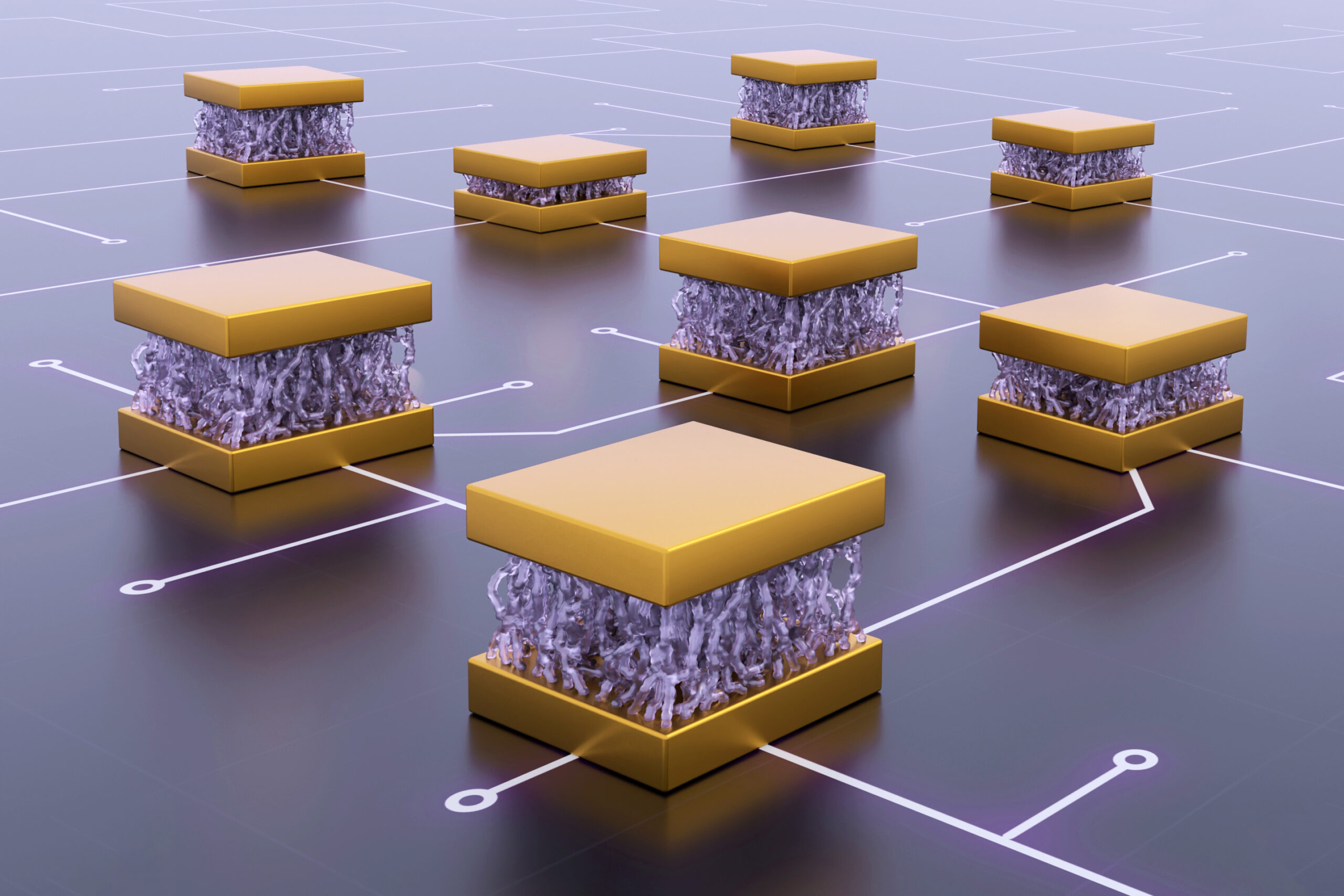
Benedikt designs and synthesizes hydrocarbon ionomers for fuel cells as a postdoc in the Swager Group. His goal is to develop materials that outperform current perfluorosulfonic acid ionomers in proton and oxygen transport under realistic operating conditions, with a particular focus on the interdisciplinary nature of this work at the interface of organic chemistry, polymer science, and engineering.
Madelyn Scott
Graduate student Madelyn Scott was recognized for her patience, ability to lead by example, and the respect, trust, and reassurance she demonstrates through her consistent personal and professional mentorship of younger graduate students in Professor Gabriela Schlau-Cohen‘s group. A nominator shared: “When I was first learning how to align a laser, Madi struck a balance that I deeply appreciated: she gave me the space to try things on my own while still being present and supportive. One moment that stood out was when I was hesitant to handle a coated mirror during a laser setup because I was afraid of damaging it. Madi respected my hesitation and reassured me that there would always be another opportunity to learn… That combination of patience and trust made a huge difference in building my confidence and independence. It’s a quality that truly defines her approach to mentorship.”
“My role as a mentor is motivated by my desire to make the lab environment an inclusive and accessible space for colleagues to learn and to grow,” said Madelyn. “I strive to empower others by providing unconditional support and the resources to feel like they belong in the scientific community.”
The overarching theme of Madelyn’s research is to steer the functional outcomes of materials through their structural design. She uses ultrafast optical spectroscopy to examine DNA excitonic assemblies, where DNA serves as a structural medium to organize synthetic chromophores into prescribed geometries. The precise structural organization of chromophores enabled by DNA encodes specific functions, such as exciton transport or charge separation. Ultimately, this work will provide a blueprint for the design and construction of artificial light-harvesting molecular machinery.