Bose grants for 2018 fund research at the frontier of discovery

Eight MIT faculty members have been awarded one of the Institute’s most respected honors: the Professor Amar G. Bose Research Grant, which supports work that is unorthodox, and potentially world-changing. The topics of the grants range from nanoscale textiles that purify drinking water, to revolutionary new approaches in catalysis, high-speed logic, and drug delivery.

The awards are named for the late Amar G. Bose ’51, SM ’52, ScD ’56, a longtime MIT faculty member and the founder of the Bose Corporation. The Bose Research Fellows for 2018 are Dirk Englund, Laura L. Kiessling, Leonid S. Levitov, Nuno F. Loureiro, Elizabeth M. Nolan, Julia Ortony, Katharina Ribbeck, and Yuriy Román. Each of this year’s grants reflects the innovative thinking, intellectually adventurous spirit, curiosity, and enthusiasm that characterize the Bose grant program. They also embody the value and practice of interdisciplinary collaboration at MIT, which drives discovery and expands the intellectual horizons of individual researchers, their colleagues, and their students.

An awards ceremony was hosted by MIT President L. Rafael Reif, and the awards were presented by MIT Provost Martin Schmidt, the Ray and Maria Stata Professor of Electrical Engineering and Computer Science. The fellows provided updates on their ongoing work at the ceremony.

As President Reif noted in his remarks, the 2018 awards carry special meaning, because they are the first to be awarded since the untimely passing in November of Vanu Gopal Bose ’87, SM ’94, PhD ’99, the son of Amar Bose and a member of the MIT Corporation. In his professional life and his service to MIT, Vanu Bose was a champion of innovation and supported many others in their pursuit of knowledge and discovery.

Novel electronic fluids for high-speed logic in quantum materials

Three investigators from the fields of quantum physics, quantum mechanics, and nuclear science and engineering will pool their expertise to explore the wonder material known as graphene. Graphene is an atomically thin carbon sheet possessing unique properties that have made it the subject of intense interest, particularly for its applications in electronics. One of those properties, says Leonid Levitov, professor of physics, is the behavior of electrons in graphene, which travel through this material “like free particles, along straight lines, ballistically, over enormous distances, and showing robust quantum-mechanical behavior up to room temperature.”

Dirk Englund, associate professor of electrical engineering and computer science, believes that insights gained from their study of graphene may advance the creation of a new logic device, capable of performing logic operations “many orders of magnitude faster and with much lower energy consumption” than the logic devices powering today’s electronics.

“Moore’s Law is coming to an end and really new concepts are needed [to] go beyond the traditional computer architecture,” Englund notes. “A lot of incremental paths have been explored already and they haven’t given us … another few orders of magnitude of performance. We have to look at radically new ideas.”

Nuno Loureiro, associate professor of nuclear science and engineering, describes his role in the project as providing “a bridge between plasma physics” — his own area of expertise — “and the fluid-like dynamics of electrons in graphene.” In his discussions with Levitov, he has come to believe that “there are methods and ideas that can be ported from one system to the other.”

“That would be a wonderful outcome” says Loureiro, particularly for exploring some of the astrophysical applications of plasma research. “It’s possible that the behavior of a graphene sheet can map directly to a pair plasma, and if we know how to read that map, we [might create] the first quote-unquote pair plasma in the lab.” He credits the Bose grant for giving him a chance to pursue this unorthodox idea, and stretch beyond his own research.

“I’m reaching to something that is completely outside of my domain of expertise, and I’m going to learn a lot. I’m hoping those ideas can then be inspiring for things in my specific domain.”

Levitov also appreciates the exchange of ideas that the project will yield.

“To a theorist, this is all particularly appealing, as it provides a unique perspective on the developments in my field by connecting it to other fields and, of course, because of a possibly far-reaching outcome this collaboration can lead to.”

Controlling infections using nature’s strategies

Our bodies are home to trillions of microbes, the vast majority of which reside in the mucus that coats our respiratory tracts, digestive systems, and other bodily systems. Yet the exact functions and molecular structures of mucus remain largely a mystery. Laura Kiessling, professor of chemistry, and Katharina Ribbeck, the Hyman Career Development Professor in Biological Engineering, will use their Bose grant to explore how mucus protects against pathogens, and use that knowledge to create mimetic, bio-inspired materials.

Ribbeck compares mucus’s long, thread-like polymers to “tiny bottle brushes, and the bristles of these brushes are sugar molecules.” These glycoproteins regulate microbial physiology by suppressing harmful pathogens and supporting the body’s diverse microbiota. “It’s hard to get down to a molecular-level understanding of how our bodies do that,” says Kiessling, but by fabricating bio-inspired materials, “we can alter their properties systematically, and ask those molecular questions that are much harder to investigate with natural materials.”

Ribbeck says her team will identify which glycoproteins have the most important effects. That knowledge then “will become the tools for [Kiessling], who will begin to build mimetic, synthetic versions of these molecular structures.” With the rise of antibiotic-resistant infections, they see enormous potential in disarming pathogens rather than killing them with antibiotics (thereby creating evolutionary pressure to become antibiotic-resistant). Instead, as Ribbeck puts it, they are “identifying nature’s strategies and then implementing them with creative chemistry.”

Kiessling and Ribbeck say that the Bose grant has enabled them to form a dynamic partnership, and pursue a high-risk, high-reward idea.

“As a scientist, you have your dreams, the stuff that keeps you awake at night,” says Ribbeck, and the research she will conduct with Bose grant support is one such project. “I am immensely grateful.” Kiessling is also excited to work on a project with broad applications: “If we can change how people think about treating infectious disease, and [move] toward exploiting natural mechanisms, that could be really transformative.”

A heavy-metal Trojan horse

One of the most serious threats to human health is the lack of new antibiotics and the rise of antibiotic-resistant disease. To tackle this problem, Elizabeth Nolan, an associate professor of chemistry, will use the Bose research grant to explore the design and delivery of nontraditional antibiotics using a Trojan horse strategy that takes advantage of the mechanisms used by bacteria to obtain iron.

“Our idea is that, since these bacteria are expressing machinery that enables iron acquisition, maybe we can take advantage of that machinery as a way to target and deliver antibacterial or toxic cargo, in a species- or strain-selective manner.” The Bose grant will enable her to “build upon [previous work] and start delivering nontraditional toxic cargo into the cell, masked as a beneficial iron chelator to the bacteria.”

This precision targeting could minimize the toxicity of drugs to the host, while addressing the problem of antibiotic resistance. It’s the type of unconventional approach that Nolan says can be challenging to fund with traditional sources. Gathering enough preliminary data to support the feasibility of a high-risk idea can be especially challenging, she adds.

With the Bose grant, Nolan can take that step, creating avenues for future research in her own lab as well as “tremendous opportunity for collaboration” with researchers in other areas of inquiry. She uses the metaphor of a tree: “We need to build the trunk right now, by making the molecules, and then once we have those, we can branch off in many different directions.”

Nolan and her colleagues have been hoping to pursue these ideas for several years, and now, she says, “we can hit the ground running. I’m delighted and very grateful.”

Functional textiles for water purification

With the support of a Bose research grant, Julia Ortony, the Finmeccanica Career Development Professor of Engineering, hopes to create simple, yet powerful, nanoscale solutions to the problem of arsenic-contaminated drinking water, a threat to the health and lives of millions in Bangladesh and other parts of South Asia.

“In our lab, we design small molecules that spontaneously self-assemble in water,” says Ortony. Their goal is to match the mechanical properties of each nanostructure with particular applications. Arsenic removal requires “very high surface area to remove trace amounts of toxins, and very robust structures so that we have very little molecular exchange.”

Current methods for removing arsenic are bulky, costly, and hard to maintain. A fabric made of nanoscale fibers would provide the surface area necessary to remove arsenic and could be functionalized with a chemical to grab arsenic ions. It would be simple to distribute and use, and could even be recharged. “We could easily modify this material remove lead or other metals,” she adds.

One inspiration behind Ortony’s proposal is a solution devised for guinea worm disease, a parasitic illness spread through drinking water. This disease was eradiated with an astoundingly simple solution: filtering drinking water through nylon fabric. Though contaminants like arsenic and lead are much more complicated to remove, Ortony believes a simple, cost-effective method utilizing nanoscale fabrics is within reach.

The Bose grant has allowed her to think more expansively about her research, created exciting opportunities for her students, and enabled her to pursue a project that engages multiple disciplines, including some that are completely new to her. “You learn a lot that way. You can bring very different ideas together, and I think that’s how a lot of discoveries and inventions are made,” she says.

Breaking away from mainstream catalysis

“The Bose grant is itself like a catalyst,” says Yuriy Román, associate professor of chemical engineering. Román’s research centers on heterogeneous catalysis, with the goal of making chemical reactions faster, more stable, and more efficient. With the support of the Bose research grant, he will embark on a new exploration: the potential of electric fields to impact molecular interactions on catalytic gas-solid surfaces.

“In our lab we work on developing strategies to enable renewable energy, implement renewable chemicals and to replace critical materials, but we have never engaged in this idea of joining the fields of electrochemistry and traditional high-temperature catalysis. It’s a completely new direction.”

The primary aims in catalysis, Román explains, are maximizing carbon economy, minimizing reactor downtime, and maximizing stability. The use of electric fields offers “an additional handle to control the catalytic process” with a high level of precision.

Román was pleased to find the very possibility he is exploring described in papers published in the 1970s by Constantinos G. Vayenas, a former professor of chemical engineering at MIT. By using today’s cutting-edge tools to examine the phenomena that Vayenas observed, Román and his team can expand Vayenas’s work, while adding new insights of their own.

While research into the unknown is a bit unnerving, Román says it also “reignites excitement” for discovery for everyone in the lab. He is grateful for the generosity of the Bose family and for the example of Professor Amar Bose, whose wide-ranging contributions and fearless spirit are inspiring. “I’m very happy that we might continue his legacy in some way.”
Unleashing perovskites’ potential for solar cells

Perovskites — a broad category of compounds that share a certain crystal structure — have attracted a great deal of attention as potential new solar-cell materials because of their low cost, flexibility, and relatively easy manufacturing process. But much remains unknown about the details of their structure and the effects of substituting different metals or other elements within the material.

Conventional solar cells made of silicon must be processed at temperatures above 1,400 degrees Celsius, using expensive equipment that limits their potential for production scaleup. In contrast, perovskites can be processed in a liquid solution at temperatures as low as 100 degrees, using inexpensive equipment. What’s more, perovskites can be deposited on a variety of substrates, including flexible plastics, enabling a variety of new uses that would be impossible with thicker, stiffer silicon wafers.

Now, researchers have been able to decipher a key aspect of the behavior of perovskites made with different formulations: With certain additives there is a kind of “sweet spot” where greater amounts will enhance performance and beyond which further amounts begin to degrade it. The findings are detailed this week in the journal Science, in a paper by former MIT postdoc Juan-Pablo Correa-Baena, MIT professors Tonio Buonassisi and Moungi Bawendi, and 18 others at MIT, the University of California at San Diego, and other institutions.

Perovskites are a family of compounds that share a three-part crystal structure. Each part can be made from any of a number of different elements or compounds — leading to a very broad range of possible formulations. Buonassisi compares designing a new perovskite to ordering from a menu, picking one (or more) from each of column A, column B, and (by convention) column X. “You can mix and match,” he says, but until now all the variations could only be studied by trial and error, since researchers had no basic understanding of what was going on in the material.

In previous research by a team from the Swiss École Polytechnique Fédérale de Lausanne, in which Correa-Baena participated, had found that adding certain alkali metals to the perovskite mix could improve the material’s efficiency at converting solar energy to electricity, from about 19 percent to about 22 percent. But at the time there was no explanation for this improvement, and no understanding of exactly what these metals were doing inside the compound. “Very little was known about how the microstructure affects the performance,” Buonassisi says.

Now, detailed mapping using high-resolution synchrotron nano-X-ray fluorescence measurements, which can probe the material with a beam just one-thousandth the width of a hair, has revealed the details of the process, with potential clues for how to improve the material’s performance even further.

It turns out that adding these alkali metals, such as cesium or rubidium, to the perovskite compound helps some of the other constituents to mix together more smoothly. As the team describes it, these additives help to “homogenize” the mixture, making it conduct electricity more easily and thus improving its efficiency as a solar cell. But, they found, that only works up to a certain point. Beyond a certain concentration, these added metals clump together, forming regions that interfere with the material’s conductivity and partly counteract the initial advantage. In between, for any given formulation of these complex compounds, is the sweet spot that provides the best performance, they found.

“It’s a big finding,” says Correa-Baena, who in January became an assistant professor of materials science and engineering at Georgia Tech. What the researchers found, after about three years of work at MIT and with collaborators at UCSD, was “what happens when you add those alkali metals, and why the performance improves.” They were able to directly observe the changes in the composition of the material, and reveal, among other things, these countervailing effects of homogenizing and clumping.

“The idea is that, based on these findings, we now know we should be looking into similar systems, in terms of adding alkali metals or other metals,” or varying other parts of the recipe, Correa-Baena says. While perovskites can have major benefits over conventional silicon solar cells, especially in terms of the low cost of setting up factories to produce them, they still require further work to boost their overall efficiency and improve their longevity, which lags significantly behind that of silicon cells.

Although the researchers have clarified the structural changes that take place in the perovskite material when adding different metals, and the resulting changes in performance, “we still don’t understand the chemistry behind this,” Correa-Baena says. That’s the subject of ongoing research by the team. The theoretical maximum efficiency of these perovskite solar cells is about 31 percent, according to Correa-Baena, and the best performance to date is around 23 percent, so there remains a significant margin for potential improvement.

Although it may take years for perovskites to realize their full potential, at least two companies are already in the process of setting up production lines, and they expect to begin selling their first modules within the next year or so. Some of these are small, transparent and colorful solar cells designed to be integrated into a building’s façade. “It’s already happening,” Correa-Baena says, “but there’s still work to do in making these more durable.”

Once issues of large-scale manufacturability, efficiency, and durability are addressed, Buonassisi says, perovskites could become a major player in the renewable energy industry. “If they succeed in making sustainable, high-efficiency modules while preserving the low cost of the manufacturing, that could be game-changing,” he says. “It could allow expansion of solar power much faster than we’ve seen.”

Perovskite solar cells “are now primary candidates for commercialization. Thus, providing deeper insights, as done in this work, contributes to future development,” says Michael Saliba, a senior researcher on the physics of soft matter at the University of Fribourg, Switzerland, who was not involved in this research.

Saliba adds, “This is great work that is shedding light on some of the most investigated materials. The use of synchrotron-based, novel techniques in combination with novel material engineering is of the highest quality, and is deserving of appearing in such a high-ranking journal.” He adds that work in this field “is rapidly progressing. Thus, having more detailed knowledge will be important for addressing future engineering challenges.”

The study, which included researchers at Purdue University and Argonne National Laboratory, in addition to those at MIT and UCSD, was supported by the U.S. Department of Energy, the National Science Foundation, the Skolkovo Institute of Science and Technology, and the California Energy Commission.

From microfluidics to metastasis

Circulating tumor cells (CTCs) — an intermediate form of cancer cell between a primary and metastatic tumor cell — carry a treasure trove of information that is critical to treating cancer. Numerous engineering advancements over the years have made it possible to extract cells via liquid biopsy and analyze them to monitor an individual patient’s response to treatment and predict relapse.

Thanks to significant progress toward creating genetically engineered mouse models, liquid biopsies hold great promise for the lab as well. These mouse models mimic many aspects of human tumor development and have enabled informative studies that cannot be performed in patients. For example, these models can be used to trace the evolution of cells from initial mutation to eventual metastasis, a process in which CTCs play a critical role. But since it has not been possible to monitor CTCs over time in mice, scientists’ ability to study important features of metastasis has been limited.

The challenge lies in capturing enough cells to conduct such longitudinal studies. Although primary tumors shed CTCs constantly, the density of CTCs in blood is very low — fewer than 100 CTCs per milliliter. For human patients undergoing liquid biopsy, this does not present a problem. Clinicians can withdraw enough blood to guarantee a sufficient sample of CTCs, just a few milliliters out of five or so liters on average, with minimal impact to the patient.

A mouse, on the other hand, only has about 1.5 milliliters of blood in total. If researchers want to study CTCs over time, they may safely withdraw no more than a few microliters of blood from a mouse each day — nowhere near enough to ensure that many (or any) CTCs are collected.

But with a new approach developed by researchers at the Koch Institute for Integrative Cancer Research, it is now possible to collect CTCs from mice over days and even weeks, and analyze them as the disease progresses. The system, described in the Proceedings of the National Academy of Sciences the week of Jan. 21, diverts blood to a microfluidic cell-sorting chip that extracts individual CTCs before returning the blood back to an awake mouse.

A menu of sorts

The inspiration for the project was cooked up, not in the lab, but during a chance encounter in the Koch Café between Tyler Jacks, director of the Koch Institute and the David H. Koch Professor of Biology, and Scott Manalis, the Andrew and Erna Viterbi Professor in the departments of Biological Engineering and Mechanical Engineering and a member of the Koch Institute.

As luck and lunch lines would have it, the pair would discuss thesis work being done by then-graduate student Shawn Davidson, who was using a dialysis-like system to track metabolites in the bloodstream of mice in the laboratory of Matthew Vander Heiden, an associate professor of biology. Jacks and Manalis were inspired: Could a similar approach could be used to study rare CTCs in real time?

Along with their Koch Institute colleague Alex K. Shalek, the Pfizer-Laubach Career Development Assistant Professor of Chemistry and a core member of the Institute for Medical Engineering and Science (IMES) at MIT, it would take Jacks and Manalis more than five years to put all the pieces of the system together, drawing from different areas of expertise around the Koch Institute. The Jacks lab supplied its fluorescent small cell lung cancer model, the Manalis lab developed the real-time CTC isolation platform, and the Shalek lab provided genomic profiles of the collected CTCs using single-cell RNA sequencing.

“This is a project that could not have succeeded without a sustained effort from several labs with very different sets of expertise. For my lab, which primarily consists of engineers, the opportunity to participate in this type of research has been incredibly exciting and is the reason why we are in the Koch Institute,” Manalis says.

The CTC sorter uses laser excitation to identify tumor cells expressing a fluorescent marker that is incorporated in the mouse model. The system draws blood from the mouse and passes it through a microfluidic chip to detect and extract the fluorescing CTCs before returning the blood back to the mouse. A minute amount of blood — approximately 100 nanoliters — is diverted with every detected CTC into a collection tube, which then is purified further to extract individual CTCs from the thousands of other blood cells.

“The real-time detection of CTCs happens at a flow rate of approximately 2 milliliters per hour which allows us to scan nearly the entire blood volume of an awake and moving mouse within an hour,” says Bashar Hamza, a graduate student in the Manalis lab and one of the lead authors on the paper.

Biology in their blood

With the development of a real-time cell sorter, the researchers could now, for the first time, longitudinally collect CTCs from the same mouse.

Previously, the low blood volume of mice and the rarity of CTCs meant that groups of mice had to be sacrificed at successive times so that their CTCs could be pooled. However, CTCs from different mice often have significantly different gene expression profiles that can obscure subtle changes that occur from the evolution of the tumor or a perturbation such as a drug.

To demonstrate that their cell-sorter could capture these differences, the researchers treated mice with a compound called JQ1, which is known to inhibit the proliferation of cancer cells and perturb gene expression. CTCs were collected and profiled with single-cell RNA sequencing for two hours prior to the treatment, and then every 24 hours after the initial treatment for four days.

When the researchers pooled data for all mice that had been treated with JQ1, they found that the data clustered based on individual mice, offering no confirmation that the drug affects CTC gene expression over time. However, when the researchers analyzed single-mouse data, they observed gene expression shift with time.

“What’s so exciting about this platform and our approach is that we finally have the opportunity to comprehensively study longitudinal CTC responses without worrying about the potentially confounding effects of mouse-to-mouse variability. I, for one, can’t wait to see what we will be able to learn as we profile more CTCs, and their matched primary and metastatic tumors,” says Shalek.

Researchers believe their approach, which they intend to use in additional cancer types including non-small cell lung, pancreatic, and breast cancer, could open new avenues of inquiry in the study of CTCs, such as studying long-term drug responses, characterizing their relationship to metastatic tumors, and measuring their rate of production in short timeframes — and the entire metastatic cascade. In future work, researchers also plan to use their approach for profiling rare immune cells and monitoring cells in dynamic contexts such as wound healing and tumor formation.

“The ability to study CTCs as well other rare cells in the blood longitudinally gives us a powerful view into cancer development. This sorter represents a real breakthrough for the field and it is a great example of the Koch Institute in action,” says Jacks.

The paper’s other co-lead authors are graduate students Sheng Rong Ng from the Jacks lab and Sanjay Prakadan from the Shalek lab. The research is supported, in part, by the Ludwig Center at MIT, the National Cancer Institute, the National Institutes of Health and the Searle Scholars Program.

Enhanced NMR reveals chemical structures in a fraction of the time

MIT researchers have developed a way to dramatically enhance the sensitivity of nuclear magnetic resonance spectroscopy (NMR), a technique used to study the structure and composition of many kinds of molecules, including proteins linked to Alzheimer’s and other diseases.

Using this new method, scientists should be able to analyze in mere minutes structures that would previously have taken years to decipher, says Robert Griffin, the Arthur Amos Noyes Professor of Chemistry. The new approach, which relies on short pulses of microwave power, could allow researchers to determine structures for many complex proteins that have been difficult to study until now.

“This technique should open extensive new areas of chemical, biological, materials, and medical science which are presently inaccessible,” says Griffin, the senior author of the study.

MIT postdoc Kong Ooi Tan is the lead author of the paper, which appears in Sciences Advances on Jan. 18. Former MIT postdocs Chen Yang and Guinevere Mathies, and Ralph Weber of Bruker BioSpin Corporation, are also authors of the paper.

Enhanced sensitivity

Traditional NMR uses the magnetic properties of atomic nuclei to reveal the structures of the molecules containing those nuclei. By using a strong magnetic field that interacts with the nuclear spins of hydrogen and other isotopically labelled atoms such as carbon or nitrogen, NMR measures a trait known as chemical shift for these nuclei. Those shifts are unique for each atom and thus serve as fingerprints, which can be further exploited to reveal how those atoms are connected.

The sensitivity of NMR depends on the atoms’ polarization — a measurement of the difference between the population of “up” and “down” nuclear spins in each spin ensemble. The greater the polarization, the greater sensitivity that can be achieved. Typically, researchers try to increase the polarization of their samples by applying a stronger magnetic field, up to 35 tesla.

Another approach, which Griffin and Richard Temkin of MIT’s Plasma Science and Fusion Center have been developing over the past 25 years, further enhances the polarization using a technique called dynamic nuclear polarization (DNP). This technique involves transferring polarization from the unpaired electrons of free radicals to hydrogen, carbon, nitrogen, or phosphorus nuclei in the sample being studied. This increases the polarization and makes it easier to discover the molecule’s structural features.

DNP is usually performed by continuously irradiating the sample with high-frequency microwaves, using an instrument called a gyrotron. This improves NMR sensitivity by about 100-fold. However, this method requires a great deal of power and doesn’t work well at higher magnetic fields that could offer even greater resolution improvements.

To overcome that problem, the MIT team came up with a way to deliver short pulses of microwave radiation, instead of continuous microwave exposure. By delivering these pulses at a specific frequency, they were able to enhance polarization by a factor of up to 200. This is similar to the improvement achieved with traditional DNP, but it requires only 7 percent of the power, and unlike traditional DNP, it can be implemented at higher magnetic fields.

“We can transfer the polarization in a very efficient way, through efficient use of microwave irradiation,” Tan says. “With continuous-wave irradiation, you just blast microwave power, and you have no control over phases or pulse length.”

Saving time

With this improvement in sensitivity, samples that would previously have taken nearly 110 years to analyze could be studied in a single day, the researchers say. In the Sciences Advances paper, they demonstrated the technique by using it to analyze standard test molecules such as a glycerol-water mixture, but they now plan to use it on more complex molecules.

One major area of interest is the amyloid beta protein that accumulates in the brains of Alzheimer’s patients. The researchers also plan to study a variety of membrane-bound proteins, such as ion channels and rhodopsins, which are light-sensitive proteins found in bacterial membranes as well as the human retina. Because the sensitivity is so great, this method can yield useful data from a much smaller sample size, which could make it easier to study proteins that are difficult to obtain in large quantities.

The research was funded by the National Institutes of Biomedical Imaging and Bioengineering, the Swiss National Science Foundation, and the German Research Foundation.

ACCESS shows grad school’s rigors and rewards

On a crisp weekend in mid-October, 24 ambitious undergraduates from across the country arrived on the MIT campus for a program pitching the benefits of a graduate education in chemistry, chemical engineering, and materials science. This program, called ACCESS, aims to increase the number of underrepresented minorities in graduate programs at MIT and other research institutions.

Among this cohort were nine chemical engineering students nominated by faculty from Stanford University, the University of North Carolina, the University of New Mexico, and the University of Houston.

“Many of these students may not understand what a doctoral degree enables them to do,” says Paula Hammond, the David H. Koch Chair Professor of Engineering and the head of the Department of Chemical Engineering. “The ACCESS program is intended to get students excited about the opportunities open to them by pursuing an advanced degree.”

To construct a vivid and detailed picture of a graduate career, the three-day ACCESS program offers a series of instructive panels, meet-and-greets with current graduate students, and networking opportunities with faculty and staff.

The visiting students stepped inside labs to speak with leading faculty researchers and with graduate students and postdoctoral researchers, who play central roles in developing research topics, shaping experimental protocols, and reporting results. Through a communications workshop, the students had a chance to work on presentation skills they would likely draw on as members of research groups, and they received advice from admissions staff on the requirements for a successful graduate application in chemical engineering.

The student visitors learned about industry experience offered through the David H. Koch Practice School, and attended a panel discussion led by alumni who described their experiences in graduate school at MIT.

Hammond touched base with some of the participants at lunch, conveying experiences from her own career. She worked in industry right after college, then after two years went to graduate school.

“It was an eye opener getting back to campus after my job,” she says. “I found I was able to dive deep into my interests — making new materials to address cancer and chronic diseases like osteoarthritis — in a way that was not possible in industry.”

Hammond noted that some students feel compelled to earn an income right out of college, but she wanted to make sure they knew they have options.

“I told them that if they grab that opportunity of graduate school right away, it’s advantageous, because they can enter industry later, but at a higher level, and they may end up running some program that creates solutions for significant problems,” she says. “I wanted to let them know that doing deep science is really fun, and very fascinating.”

While many of the ACCESS students had not yet made decisions about attending graduate school, Hammond says she hopes to highlight the advantages of an MIT education.

“All kinds of people make it at MIT — people who are bringing it from top universities, and from historically black colleges, and from state schools,” she says. “What this diversity of people brings makes us better, because at MIT, it’s not just about using technology to solve problems, but caring and thinking hard about what problems we should be solving.”

In addition to the formal events at MIT organized around pursuit of an academic career, ACCESS built in social occasions, which introduced visiting students to city life in Boston and Cambridge. These included a duck boat tour and a final dinner reception at the MIT Museum, where program participants from all three departments connected to share reactions and experiences over the weekend.

By the end of the weekend, students said they felt they had a new and valuable perspective on their post-undergraduate choices.

“The MIT ACCESS Program was an incredible experience that I am so grateful for,” says Emily Barefoot, a sophomore majoring in chemical and biomolecular engineering at North Carolina State University. “The grad students and faculty showed me that a graduate education in chemical engineering is not only possible but encouraged [if you are] an underrepresented student.”

School of Science honors postdocs and research staff with 2018 Infinite Kilometer Awards

The MIT School of Science has announced the 2018 winners of the Infinite Kilometer Award. The Infinite Kilometer Award was established in 2012 to highlight and reward the extraordinary work of the school’s postdocs and research staff.

Recipients of the award are exceptional contributors to their research programs. In many cases, they are also deeply committed to their local or global MIT community, and are frequently involved in mentoring and advising their junior colleagues, participating in the school’s educational programs, making contributions to the MIT Postdoctoral Association, or contributing to some other facet of the MIT community.

In addition to a monetary award, the honorees and their colleagues, friends, and family are invited to a celebratory reception in the spring semester.

The 2018 Infinite Kilometer winners are:

Matthew Golder, a National Institutes of Health Postdoctoral Fellow in the Department of Chemistry, nominated by Jeremiah Johnson, an associate professor of chemistry;

Robert Grant, manager of the crystallography lab in the Department of Biology, nominated by Michael Laub, a professor of biology;

Slawomir Gras, a research scientist on the LIGO project at the MIT Kavli Institute for Astrophysics and Space Research, nominated by Nergis Mavalvala, the Curtis and Kathleen Marble Professor of Astrophysics, and Matthew Evans, an associate professor of physics;

Yeong Shin Yim, a postdoc at the McGovern Institute for Brain Research, nominated by Gloria Choi, an assistant professor of brain and cognitive sciences; and

Yong Zhao, a postdoc in the Laboratory for Nuclear Science, nominated by Iain Stewart, a professor of physics.

The School of Science is also currently accepting nominations for its Infinite Mile Awards. All School of Science employees are eligible, and nominations are due by Feb. 15, 2019. The Infinite Mile Awards will be presented with the Infinite Kilometer Awards this spring.

Engineering “capture compounds”to probe cell growth

In 1969, scientist Michael Cashel was analyzing the compounds produced by starved bacteria when he noticed two spots appearing on his chromatogram as if by magic. Today, we know one of these “magic spots,” as researchers call them, as guanosine tetraphosphate, or ppGpp for short. We also understand that it is a signaling molecule present in virtually all bacteria, helping tune cell growth and size based on nutrient availability.

And yet, despite decades of study, precisely how ppGpp regulates bacterial growth has remained rather mysterious. Delving further requires a more comprehensive list of the molecules that ppGpp binds to exert its effects.

Now, collaborators from MIT’s departments of Biology and Chemistry have developed a method to do just that, and used their new approach to pinpoint over 50 ppGpp targets in Escherichia coli — roughly half which had not been identified previously. Many of these targets are enzymes required to produce nucleotides, the building blocks of DNA and RNA. During times when the bacteria do not have enough nutrients to grow and divide normally, the researchers propose that ppGpp prevents these enzymes from creating new nucleotides from scratch, helping cells enter a dormant state.

“With small molecules or metabolites like ppGpp, it’s been difficult historically to determine which proteins they bind,” says Michael Laub, a professor of biology, a Howard Hughes Medical Institute investigator, and the senior author of the study. “This has been an intractable problem that’s held the field back for some time, but our new approach allows you to nail down the likely targets in a matter of weeks.”

Postdoc Boyuan Wang is the first author of the study, of which Bradley L. Pentelute was a contributor, and which appeared in Nature Chemical Biology on Dec. 17.

The magic spot

Since ppGpp was discovered nearly 50 years ago, it has been shown to suppress DNA replication, transcription, translation, and various metabolic pathways. It puts the brakes on cell growth and allows bacteria to persist in the face of starvation, stress, and antibiotics. Its influence over numerous regulatory processes has remained somewhat of a mystery, however — after all, it doesn’t just modulate a single pathway but coordinates multiple operations simultaneously to orchestrate a mass shutdown of the cell.

In order to discern which proteins ppGpp binds to effect such widespread change, the researchers built what they call “capture compounds” that contain ppGpp, allowing them to fish out its targets from bacterial extracts. These compounds included a photoreactive crosslinker that latched tightly onto the proteins of interest in the presence of light, and a biotin handle that helped the scientists pull out the proteins to identify them. Most importantly, they were joined to ppGpp in such a way that they wouldn’t interfere with its ability to bind to its targets. This method is more efficient and accurate compared to more traditional means of distinguishing ppGpp targets, which are far more arduous and lack sensitivity.

“Our approach solves these problems because you’re no longer required to do such labor-intensive protocols in order to identify ppGpp targets — and it works even in bacteria beyond E. coli,” says Wang. “Although ppGpp is common among many bacterial species, it seems to exert its effects through different mechanisms, which complicates things. Our capture compounds provide a way to unravel this diversity, and in short order.”

Putting the brakes on nucleotide production

Although the 56 ppGpp targets Wang identified in his screen control a myriad of cellular processes, he homed in on the enzyme PurF — which initiates the biosynthesis of purine nucleotides bearing adenine and guanine bases, also known as A and G.

When bacteria are stressed or starved, they enter a dormant state to survive. But simply curbing translation and transcription is not enough; nucleotides are still being generated and will build up if their synthesis is not put on pause. Cells can build nucleotides in one of two ways: either by salvaging existing materials or starting completely from scratch. PurF kicks off the first step in the latter process leading to the A and G nucleotides. However, when ppGpp binds to PurF, it causes the enzyme to change its shape, which prevents it from doing its job, thus reducing nucleotide production in the cell.

“This is the first time that an enzyme involved in that specific pathway or function has been identified as a ppGpp target,” Wang says. “If you limit the consumption of nucleotides but not their production, the nucleotide pool is going to explode, which isn’t good for the cell. So we’ve shown that ppGpp actually addresses this problem as well.”

In addition to PurF and other enzymes required for nucleotide production, the researchers noticed that ppGpp also binds to many GTPase enzymes involved in translation. This could indicate a failsafe mechanism slowing down translation by striking multiple, similar enzymes in an almost redundant manner in the face of starvation.

As Wang continues to refine his method, he aims to increase its specificity and ensure his capture compounds bind to the exact same proteins they would inside a live cell. He also hopes to screen for ppGpp binding proteins in other bacteria, including pathogens that rely on ppGpp to survive within their hosts and propagate conditions like tuberculosis.

“This is an exciting chemical approach to better understand the function of a long-studied conserved signaling molecule in bacteria,” says Jue Wang, professor of bacteriology at the University of Wisconsin at Madison, who was not involved with the study. “Their findings and techniques are highly relevant to many other bacteria, and will greatly improve knowledge of how bacteria use this critical signaling molecule to mediate everything from surviving in the human gut to causing disease.”

Adds Laub: “We are still discovering new nucleotide-based signaling molecules in bacteria even today, and every single one of them could eventually be derivatized in a similar way to identify their binding partners.”

This research was supported by a fellowship from the Jane Coffin Childs Memorial Fund for Medical Research and a grant from the National Institutes of Health.

Cracking a tough case

For hundreds of millions of years, plants thrived in the Earth’s oceans, safe from harsh conditions found on land, such as drought and ultraviolet radiation. Then, roughly 450 million years ago, plants found a way to make the move to land: They evolved spores — small reproductive cells — and eventually pollen grains with tough, protective outer walls that could withstand the harsh conditions in the terrestrial environment until they could germinate and grow into a plant or fertilize an ovule.

A key component of the walls is a polymer — a large molecule made up of many small subunits — called sporopollenin. It is durable and remains ubiquitous in all land plants to this day, but is absent in algae. Understanding the molecular composition of polymers found in nature is a fundamental pursuit of biology, with a long history tracing back to the early days of elucidating DNA and protein structures, but the toughness that makes sporopollenin so important for all land plants also makes it tough for researchers to study.

Sporopollenin is extremely inert and resistant to reacting with other chemicals, including the ones researchers typically use to determine the structures of other plant biopolymers, such as polysaccharides, lignin, and natural rubber. Consequently, scientists have struggled for decades to figure out exactly what the sporopollenin polymer is made of. Now, in an article published today in the journal Nature Plants, Whitehead Institute Member Jing-Ke Weng and first author and Weng lab postdoc Fu-Shuang Li, together with collaborators Professor Mei Hong and graduate student Pyae Phyo from the Department of Chemistry, have used innovative chemical degradation methods and state-of-the-art nuclear magnetic resonance (NMR) spectroscopy to determine the chemical structure of sporopollenin.

“Plants could not have colonized the land if they had not developed a way to withstand harsh environments,” says Weng, who is also an assistant professor of biology. “Sporopollenin helped make the terrestrial ecosystem as we know it possible.”

In addition to solving a longstanding puzzle in plant chemistry, identifying the structure of sporopollenin opens the door for its potential use in a host of other applications. Sporopollenin’s inertness is a desirable attribute to replicate in the development of, for example, medical implants such as stents, which prop open clogged arteries, to prevent negative interactions between the device and the body. It could also be a good model for durable paints and coatings, such as those used on boats, where its inertness would prevent reactions with compounds in the water and so protect the ship’s hull from environmental degradation.

Finding the shape and composition of sporopollenin was not a simple task. The first challenge was getting enough of the material to study, as pollen amounts that can be collected from most plants are minute. However, pollen from the pitch pine, Pinus rigida, is sold in bulk in China as a topping for rice cakes. So Weng used an unconventional sample collection method: He asked his parents in China to ship him copious quantities of pitch pine pollen.

A common approach to determine a complex plant polymer’s structure is to dissolve it in solutions with specific chemical compounds that will break it apart into smaller and smaller pieces from which the complete structure can be deduced. But since sporopollenin is inert and does not react with the researchers’ usual cadre of chemicals, figuring out how to break down the molecule was a key challenge.

In order to crack this problem — and make the sporopollenin dissolve more easily — Li used a specially designed grinder known as a high-energy ball mill to physically shear the tiny pollen coat into even finer pieces. Then he began testing different chemical mixtures to find ones that could break apart the sporopollenin polymer into more accessible fragments.

The big breakthrough came when he tried a chemical degradation process called thioacidolysis, an acid-catalyzed reaction with a pinch of a special sulfur-containing compound. This allowed Li to consistently break down 50 percent of the total sporopollenin polymer into small pieces, with the structure of each of these pieces resolved one by one.

To help complete the puzzle, the researchers collaborated with Mei Hong’s group in MIT’s Department of Chemistry and used magic-angle-spinning solid-state NMR spectroscopy, which can determine the chemical structures of insoluble compounds by having them interact with magnetic fields. This investigation narrowed the possible structures for sporopollenin. Combined with more chemical degradation tests to verify certain possibilities and eliminate others, it ultimately led to the complete structure.

With the structure of sporopollenin in hand, the researchers were then able to identify aspects of this unique polymer that make it such a good protective wall for spores and pollen.

A key finding was that sporopollenin molecules contain two types of cross-linkages — esters and acetals — that act like chemical clips, binding the chains of the molecule together. Other known plant polymers have only one main type of cross-link, and this unique characteristic likely provides the extreme chemical inertness of sporopollenin. Ester bonds are resistant to mildly acidic conditions, while acetals are resistant to basic conditions, meaning the molecule won’t break down in either type of environment in the wild or in the lab.

Other components of sporopollenin that the researchers found include multiple molecules known to provide UV protection, as well as fatty acids, which are water resistant and may protect spores and pollen from drought or other changes in water availability.

The researchers are now looking for differences in sporopollenin between species. Pine is not a flowering plant, but the majority of plants of interest to agriculture and medicine are, so Weng and Li are investigating how sporopollenin may have changed with the evolution of the flowering plants.

“Since I was a student, inspired by the magnificent discovery of the structure of DNA, I have been driven to discover the fundamental forms of things in nature,” Weng says. “It has been so rewarding to illuminate the structure of this crucial biopolymer in plants.”

Jing-Ke Weng’s primary affiliation is with Whitehead Institute for Biomedical Research, where his laboratory is located and all his research is conducted. He is also an assistant professor of biology at MIT. The research was supported by the Pew Scholar Program in the Biomedical Sciences and the Searle Scholars Program, and the U.S. Department of Energy.

Understanding how plants use sunlight

Plants protect themselves from intense sunlight by rejecting much of it as heat — sometimes far more than needed to prevent damage. Engineering plants to be less cautious could significantly increase yields of biomass for fuel and crops for food, but exactly how the photoprotection system turns on and off has remained unclear.

MIT researchers have now gathered new insights into the protein that controls the switch. They zapped individual copies of that protein with a laser and used a highly sensitive microscope to measure the fluorescence emitted by each protein in response. Based on those tests, they concluded that there are two distinct mechanisms by which the dissipation of heat begins. One is a split-second response to a sudden increase in sunlight, say, after a cloud passes by, while the other activates over minutes to hours as light gradually changes during sunrise or sunset. In both cases, the response is triggered by a specific change in the protein’s structure.

Plants rely on the energy in sunlight to produce the nutrients they need. But sometimes they absorb more energy than they can use, and that excess can damage critical proteins. To protect themselves, they convert the excess energy into heat and send it back out. Under some conditions, they may reject as much as 70 percent of all the solar energy they absorb.

“If plants didn’t waste so much of the sun’s energy unnecessarily, they could be producing more biomass,” says Gabriela S. Schlau-Cohen, the Cabot Career Development Assistant Professor of Chemistry. Indeed, scientists estimate that algae could grow as much as 30 percent more material for use as biofuel. More importantly, the world could increase crop yields — a change needed to prevent the significant shortfall between agricultural output and demand for food expected by 2050.

The challenge has been to figure out exactly how the photoprotection system in plants works at the molecular level, in the first 250 picoseconds of the photosynthesis process. (A picosecond is a trillionth of a second.)

“If we could understand how absorbed energy is converted to heat, we might be able to rewire that process to optimize the overall production of biomass and crops,” says Schlau-Cohen. “We could control that switch to make plants less hesitant to shut off the protection. They could still be protected to some extent, and even if a few individuals died, there’d be an increase in the productivity of the remaining population.”

First steps of photosynthesis

Critical to the first steps of photosynthesis are proteins called light-harvesting complexes, or LHCs. When sunlight strikes a leaf, each photon (particle of light) delivers energy that excites an LHC. That excitation passes from one LHC to another until it reaches a so-called reaction center, where it drives chemical reactions that split water into oxygen gas, which is released, and positively charged particles called protons, which remain. The protons activate the production of an enzyme that drives the formation of energy-rich carbohydrates needed to fuel the plant’s metabolism.

But in bright sunlight, protons may form more quickly than the enzyme can use them, and the accumulating protons signal that excess energy is being absorbed and may damage critical components of the plant’s molecular machinery. So some plants have a special type of LHC — called a light-harvesting complex stress-related, or LHCSR — whose job is to intervene. If proton buildup indicates that too much sunlight is being harvested, the LHCSR flips the switch, and some of the energy is dissipated as heat.

It’s a highly effective form of sunscreen for plants — but the LHCSR is reluctant to switch off that quenching setting. When the sun is shining brightly, the LHCSR has quenching turned on. When a passing cloud or flock of birds blocks the sun, it could switch it off and soak up all the available sunlight. But instead, the LHCSR leaves it on — just in case the sun suddenly comes back. As a result, plants reject a lot of energy that they could be using to build more plant material.

An evolutionary success

Much research has focused on the quenching mechanism that regulates the flow of energy within a leaf to prevent damage. Optimized by 3.5 billion years of evolution, its capabilities are impressive. First, it can deal with wildly varying energy inputs. In a single day, the sun’s intensity can increase and decrease by a factor of 100 or even 1,000. And it can react to changes that occur slowly over time — say, at sunrise — and those that happen in just seconds, for example, due to a passing cloud.

Researchers agree that one key to quenching is a pigment within the LHCSR — called a carotenoid — that can take two forms: violaxanthin (Vio) and zeaxanthin (Zea). They’ve observed that LHCSR samples are dominated by Vio molecules under low-light conditions and Zea molecules under high-light conditions. Conversion from Vio to Zea would change various electronic properties of the carotenoids, which could explain the activation of quenching. However, it doesn’t happen quickly enough to respond to a passing cloud. That type of fast change could be a direct response to the buildup of protons, which causes a difference in pH from one region of the LHCSR to another.

Clarifying those photoprotection mechanisms experimentally has proved difficult. Examining the behavior of samples containing thousands of proteins doesn’t provide insights into the molecular-level behavior because various quenching mechanisms occur simultaneously and on different time scales — and in some cases, so quickly that they’re difficult or impossible to observe experimentally.

Testing the behavior of proteins one at a time

Schlau-Cohen and her MIT chemistry colleagues, postdoc Toru Kondo and graduate student Wei Jia Chen, decided to take another tack. Focusing on the LHCSR found in green algae and moss, they examined what was different about the way that stress-related proteins rich in Vio and those rich in Zea respond to light — and they did it one protein at a time.

According to Schlau-Cohen, their approach was made possible by the work of her collaborator Roberto Bassi and his colleagues Alberta Pinnola and Luca Dall’Osto at the University of Verona, in Italy. In earlier research, they had figured out how to purify the individual proteins known to play key roles in quenching. They thus were able to provide samples of individual LHCSRs, some enriched with Vio carotenoids and some with Zea carotenoids.

To test the response to light exposure, Schlau-Cohen’s team uses a laser to shine picosecond light pulses onto a single LHCSR. Using a highly sensitive microscope, they can then detect the fluorescence emitted in response. If the LHCSR is in quench-on mode, it will turn much of the incoming energy into heat and expel it. Little or no energy will be left to be reemitted as fluorescence. But if the LHCSR is in quench-off mode, all of the incoming light will come out as fluorescence.

“So we’re not measuring the quenching directly,” says Schlau-Cohen. “We’re using decreases in fluorescence as a signature of quenching. As the fluorescence goes down, the quenching goes up.”

Using that technique, the MIT researchers examined the two proposed quenching mechanisms: the conversion of Vio to Zea and a direct response to a high proton concentration.

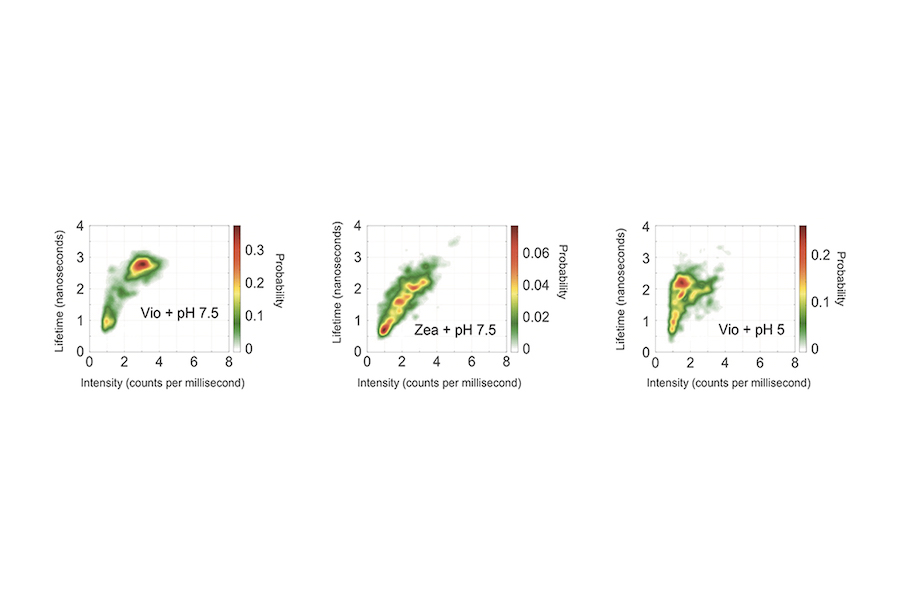
To address the first mechanism, they characterized the response of the Vio-rich and Zea-rich LHCSRs to the pulsed laser light using two measures: the intensity of the fluorescence (based on how many photons they detect in one millisecond) and its lifetime (based on the arrival time of the individual photons).

Three graphs depicting various results

Using the measured intensities and lifetimes of responses from hundreds of individual LHCSR proteins, they generated the probability distributions shown in the figure above. In each case, the red region shows the most likely outcome based on results from all the single-molecule tests. Outcomes in the yellow region are less likely, and those in the green region are least likely.

The left figure shows the likelihood of intensity-lifetime combinations in the Vio samples, representing the behavior of the quench-off response. Moving to the Zea results in the middle figure, the population shifts to a shorter lifetime and also to a much lower-intensity state — an outcome consistent with Zea being the quench-on state.

To explore the impact of proton concentration, the researchers changed the pH of their system. The results just described came from individual proteins suspended in a solution with a pH of 7.5. In parallel tests, the researchers suspended the proteins in an acidic solution of pH 5, thus in the presence of abundant protons, replicating conditions that would prevail under bright sunlight.

The right figure shows results from the Vio samples. Shifting from pH 7.5 to pH 5 brings a significant decrease in intensity, as it did with the Zea samples, so quenching is now on. But it brings only a slightly shorter lifetime, not the significantly shorter lifetime observed with Zea.

The dramatic decrease in intensity with the Vio-to-Zea conversion and the lowered pH suggests that both are quenching behaviors. But the different impact on lifetime suggests that the quenching mechanisms are different.

“Because the most likely outcome—the red region—moves in different directions, we know that two distinct quenching processes are involved,” says Schlau-Cohen.

Their investigation brought one more interesting observation. The intensity-lifetime results for Vio and Zea in the two pH environments are consistent when they’re taken at time intervals spanning seconds or even minutes in a given sample. According to Schlau-Cohen, the only explanation for such stability is that the responses are due to differing structures, or conformations, of the protein.

“It was known that both pH and the switch of the carotenoid from violaxanthin to zeaxanthin played a role in quenching,” she says. “But what we saw was that there are two different conformational switches at work.”

Based on their results, Schlau-Cohen proposes that the LHCSR can have three distinct conformations. When sunlight is dim, it assumes a conformation that allows all available energy to come in. If bright sunlight suddenly returns, protons quickly build up and reach a critical concentration at which point the LHCSR switches to a quenching-on conformation — probably a more rigid structure that permits energy to be rejected by some mechanism not yet fully understood. And when light increases slowly, the protons accumulate over time, activating an enzyme that in turn accumulates, in the process causing a carotenoid in the LHCSR to change from Vio to Zea — a change in both composition and structure.

“So the former quenching mechanism works in a few seconds, while the latter works over time scales of minutes to hours,” says Schlau-Cohen. Together, those conformational options explain the remarkable control system that enables plants to regulate energy uptake from a source that’s constantly changing.

Exploring what comes next

Schlau-Cohen is now turning her attention to the next important step in photosynthesis — the rapid transfer of energy through the network of LHCs to the reaction center. The structure of individual LHCs has a major impact on how quickly excitation energy can jump from one protein to the next. Some investigators are therefore exploring how the LHC structure may be affected by interactions between the protein and the lipid membrane in which it’s suspended.

However, their experiments typically involve sample proteins mixed with detergent, and while detergent is similar to natural lipids in some ways, its impact on proteins can be very different, says Schlau-Cohen. She and her colleagues have therefore developed a new system that suspends single proteins in lipids more like those found in natural membranes. Already, tests using ultrafast spectroscopy on those samples has shown that one key energy-transfer step occurs 30 percent faster than measured in detergents. Those results support the value of the new technique in exploring photosynthesis and demonstrate the importance of using near-native lipid environments in such studies.

Research on the heat-dissipation mechanism was supported by the Center for Excitonics, an Energy Frontier Research Center funded by the US Department of Energy; a CIFAR Azrieli Global Scholar Award; and the European Economic Community projects AccliPhot and SE2B. Research on energy transfer was supported by the US Department of Energy, Office of Science, Office of Basic Energy, and by the Singapore-MIT Alliance for Research and Technology. Further information can be found in:

This article appears in the Autumn 2018 issue of Energy Futures, the magazine of the MIT Energy Initiative.

New drug combination could be more effective against melanoma

A class of cancer drugs called protein kinase inhibitors is one of the most effective treatments for melanoma. However, in many cases, tumors eventually become resistant to the drugs and cause a relapse in the patient.

A new study from MIT suggests that combining kinase inhibitors with experimental drugs known as ribonucleases could lead to better results. In tests with human cancer cells, the researchers found that the two drugs given together kill cells much more effectively than either drug does on its own. The combination could also help to prevent tumors from developing drug resistance, says Ronald Raines, the Firmenich Professor of Chemistry at MIT.

“We discovered that this ribonuclease drug could be paired favorably with other cancer chemotherapeutic agents, and not only that, the pairing made logical sense in terms of the underlying biochemistry,” Raines says.

Raines is the senior author of the study, which appears in the Dec. 3 issue of Molecular Cancer Therapeutics and was posted in the journal’s “online first” section on Nov. 20. Trish Hoang, a former graduate student at the University of Wisconsin at Madison, is the lead author of the study.

Unexpected link

Ribonucleases are enzymes produced by all human cells that break down RNA molecules. They degrade cellular RNA that is no longer needed, and they help to defend against viral RNA. Because of ribonucleases’ ability to kill cells by damaging their RNA, Raines has been working on developing these enzymes as cancer drugs for about two decades.

His lab has also been studying the protein that has evolved to help cells defend against ribonucleases, which can be very destructive if unchecked. This protein, called ribonuclease inhibitor, binds to ribonucleases with a half-life of at least three months — the strongest naturally occurring protein-binding interaction ever recorded. “That means that should ribonuclease invade cells, there is an unbelievable defense system,” Raines says.

To create a ribonuclease drug for testing, the researchers modified it so that ribonuclease inhibitors don’t bind as tightly — the half-life for the interaction is only a few seconds. One version of this drug is now in a phase 1 clinical trial, where it has stabilized the disease in about 20 percent of patients.

In the new study, the researchers found an unexpected link between ribonucleases and enzymes called protein kinases (the targets of protein kinase inhibitors), which led them to discover that the two drugs can kill cancer cells much better when used together than either one can alone.

The discovery came about when Hoang decided to try to produce the ribonuclease inhibitor protein in human cells instead of in E. coli, which Raines’ lab normally uses to produce the protein. She found that the human-cell-produced version, though identical in amino acid sequence to the protein produced by bacteria, bound to ribonucleases 100 times more strongly. This boosted the half-life of the interaction from months to decades — a protein-binding strength previously unheard of.

The researchers hypothesized that human cells were somehow modifying the inhibitor in a way that made it bind more tightly. Their studies revealed that, indeed, the inhibitor produced by human cells had phosphate groups added to it. This “phosphorylation” made the inhibitor bind much more strongly than anyone had previously suspected.

The researchers also discovered that phosphorylation was being carried out by protein kinases that are part of a cell signaling pathway called ERK. This pathway, which controls how cells respond to growth factors, is often overactive in cancer cells. The protein kinase inhibitors trametinib and dabrafenib, used to treat melanoma, can shut off the ERK pathway.

“This was a fortuitous intersection of two different strategies, because we reasoned that if we could use these drugs to deter the phosphorylation of ribonuclease inhibitor, then we could make the ribonucleases more potent at killing cancer cells,” Raines says.

Combating resistance

Tests of human melanoma cells supported this idea. The combination of a kinase inhibitor plus a ribonuclease was much deadlier to cancer cells, and the drugs were effective at lower concentrations. The kinase inhibitor prevented the ribonuclease inhibitor from being phosphorylated, making it weaker and allowing the ribonuclease more freedom to perform its function and destroy RNA.

If the same holds true in human patients, this approach could lead to reduced side effects and a lower chance of tumor cells becoming drug-resistant, Raines says. The researchers now hope to test this drug combination in mice, as a step toward testing the combination in clinical trials.

“We’re hoping that we can explore relationships with some of the many pharmaceutical companies that develop ERK pathway inhibitors, to team up and use our ribonuclease drug in concert with kinase inhibitors,” Raines says.

The researchers have also engineered mice that do not produce ribonucleases, which they plan to use to further study the biological functions of these enzymes.

The research was funded by the National Institutes of Health.