MIT and Broad Institute Researchers Break Diffraction Barrier in Super-Resolution Microscopy
A surprising discovery in optical materials allows scientists to visualize the molecular machinery of life with exceptional detail and simplified equipment.
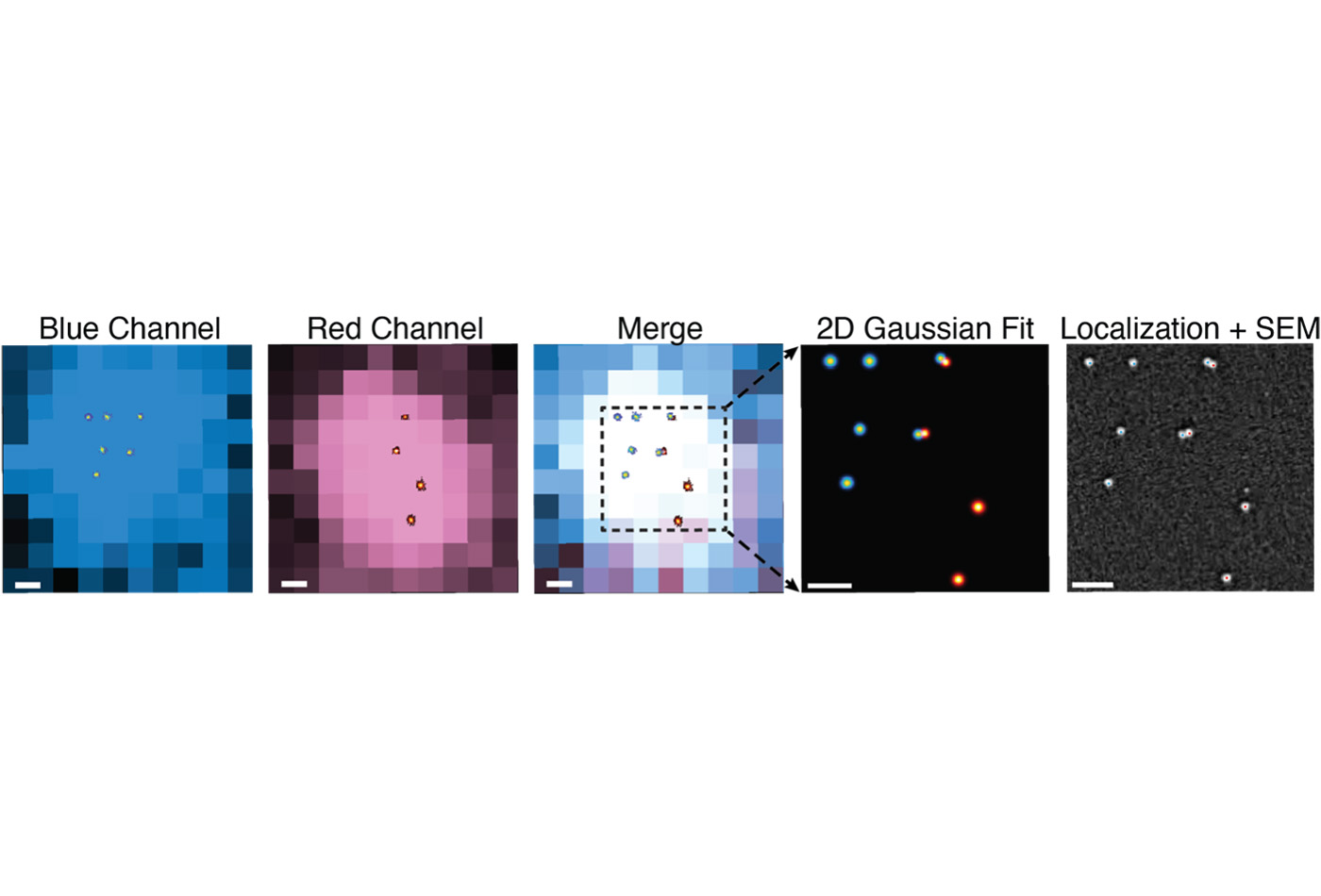
Researchers in the lab of Sam Peng, Pfizer Inc. – Gerald Laubach Career Development Assistant Professor of Chemistry and Core Institute Member of the Broad Institute, have developed a groundbreaking super-resolution imaging platform called U-STORM (Upconversion enabled Stochastic Optical Reconstruction Microscopy). This new technology allows scientists to visualize molecular structures with sub-Ångström-level localization precision—three orders of magnitude beyond the nanometer limits of standard fluorescent dyes—while drastically simplifying the imaging process. Unlike traditional dyes that fade rapidly under illumination and limit data collection, U-STORM utilizes a new class of compositionally engineered upconverting nanoparticles (UCNPs) that blink spontaneously and indefinitely. The study represents a fundamental shift in both optical materials and biological imaging, and was recently published in Nature Nanotechnology.
Overturning a Decades-Old Paradigm
For decades, the scientific community widely considered upconverting nanoparticles to be completely photostable and non-blinking. Because localization-based super-resolution microscopy techniques like STORM rely entirely on the stochastic “blinking” (switching between ON and OFF states) of light emitters to distinguish closely packed molecules, UCNPs were historically deemed unsuitable for this type of imaging.
“Our laboratory has long been interested in overcoming these limitations,” said Peng. “Our work began with a question: Can we develop a super-resolution imaging platform that is simultaneously long-term, multicolor, simple to operate, and capable of achieving extremely high localization precision without using imaging buffers or additional optical control?”
By meticulously controlling nanoparticle composition, the MIT and Broad Institute team discovered that these small (~10 nm) core-shell particles could actually be coaxed into spontaneous blinking under continuous near-infrared (NIR) excitation. Remarkably, this blinking behavior continues indefinitely without the need for complex imaging buffers, oxygen scavengers, or external optical modulation.
U-STORM’s Key Breakthroughs
An Ångström is a tiny unit of measurement used by chemists to measure size and distances at the atomic level. U-STORM’s ability to blink indefinitely has afforded researchers the opportunity to collect over 88,000 localization events from the same particle, sharpening the localization precision down to an unprecedented 0.6 Ångström.
Unlike conventional multicolor super resolution imaging, which requires multiple expensive lasers and meticulous optical alignment, U-STORM can operate with just one near-infared laser, which works to simultaneously excite nanoparticles emitting different colors. This results in a drastic reduction of an experiment’s complexity.
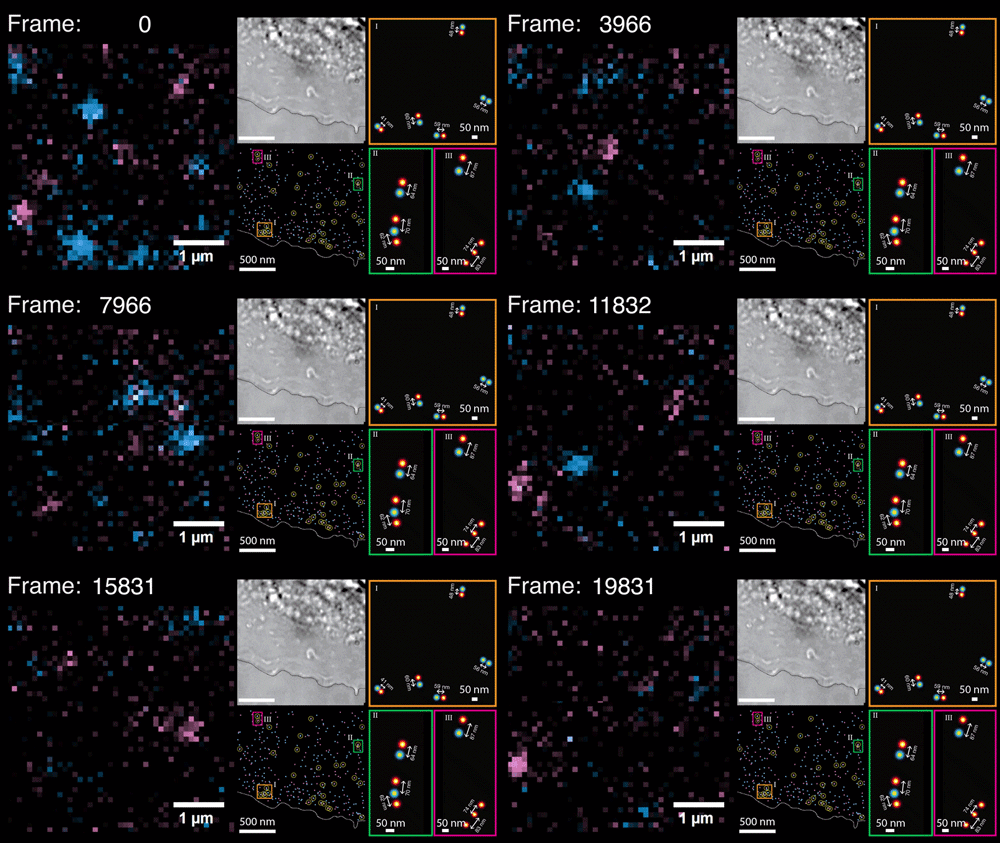 To obtain images with multiple colors, rather than capturing images sequentially over multiple rounds, U-STORM captures multiple colors simultaneously. Researchers have successfully demonstrated this by mapping epidermal growth factor receptor (EGFR) dimers and multimers in biological samples under physiological conditions without any specialized imaging buffers.
Broader Impact
Beyond expanding the boundaries of microscopy, this research establishes an entirely new design principle for lanthanide nanomaterials. The team is already working to expand the color palette, make the particles even smaller and brighter, and deploy U-STORM to investigate complex nanoscale protein organizations and cellular signaling pathways.
Ultimately, U-STORM promises to provide laboratories worldwide with an accessible, easy-to-implement, yet incredibly powerful route toward high-precision molecular imaging.