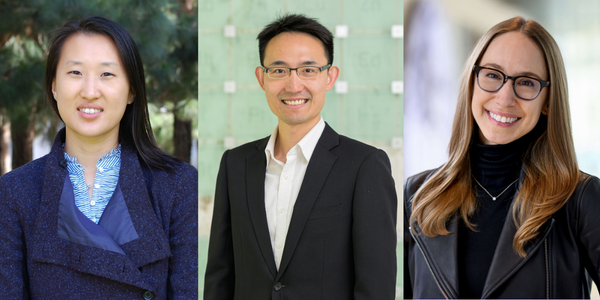
Three MIT Faculty receive Awards from National Institute of Health High-Risk, High-Reward Program
The 2026 NIH Director’s Awards support exceptionally creative scientists pursuing transformative research.
On Oct. 6, the National Institutes of Health announced the names of The National Institutes of Health awarded 58 new research grants through its High-Risk, High-Reward Research program to support exceptionally innovative research with the potential for broad impact on biomedical and behavioral science. Three of the recipients are MIT faculty members.
This year’s funded projects include harnessing AI to accelerate discoveries for improved cancer treatments, helping stroke survivors regain natural speech and communication, advancing placenta research to develop new treatments for preeclampsia, and unlocking existing drug therapies to treat hundreds of rare diseases.
The 58 awards, totaling approximately $237.5 million, will support investigators pursuing bold ideas that challenge conventional approaches and could open new pathways to scientific discovery. Awards will begin in 2026 and provide support for up to five years, pending the availability of funds.
The High-Risk, High-Reward Research program supports researchers at different career stages who propose highly innovative research that may be difficult to pursue with traditional NIH funding mechanisms. The program encourages investigators to think beyond established scientific boundaries and to pursue revolutionary ideas across the NIH mission to advance knowledge and enhance health.
New Innovator Awardees
Three MIT researchers received an NIH Director’s New Innovator Award, which recognizes “exceptional creativity proposing bold, highly innovative and impactful research.” They are:
- Yinyin Erin Chen, the Robert A. Swanson (1969) Career Development Professor of Life Sciences in the Department of Biology, a core member of the Broad Institute of MIT and Harvard, and an attending dermatologist at Massachusetts General Hospital. Her New Innovator Award will fund research on how bacteria living on the skin can generate T cell responses that combat disease without causing inflammation. Insights from this work could potentially lead to new immunotherapies.
- Sam Peng, the Pfizer Inc. Gerald Laubach Career Development Assistant Professor of Chemistry and a core member of the Broad Institute of MIT and Harvard. Professor Peng’s New Innovator Award will support the development of novel single-molecule microscopy techniques to study the mechanisms of G-protein-coupled receptor (GPCR) signaling pathways. GPCRs mediate the signaling of many hormones and neurotransmitters and their dysregulation can lead to a range of diseases. This research could contribute to the development of new therapeutics.
- Jessica Stark, the Underwood-Prescott Career Development Professor in the Departments of Biological Engineering and Chemical Engineering and an intramural member of the Koch Institute for Integrative Cancer Research at MIT. Her New Innovator award will engineer proteins to understand and rewire signaling at immune synapses. This work promises to help us better understand how immune cells make decisions and to inform development of immunotherapies to treat a wide range of human diseases.
This year NIH issued 7 Pioneer Awards, 42 New Innovator Awards, 6 Transformative Research Awards, and 3 Early Independence Awards in 2026. Funding for the awards comes from the NIH Common Fund, the National Institute of Environmental Health Sciences (NIEHS), the National Institute on Deafness and Other Communication Disorders (NIDCD), and the Office of Research Innovation, Validation, and Application (ORIVA).