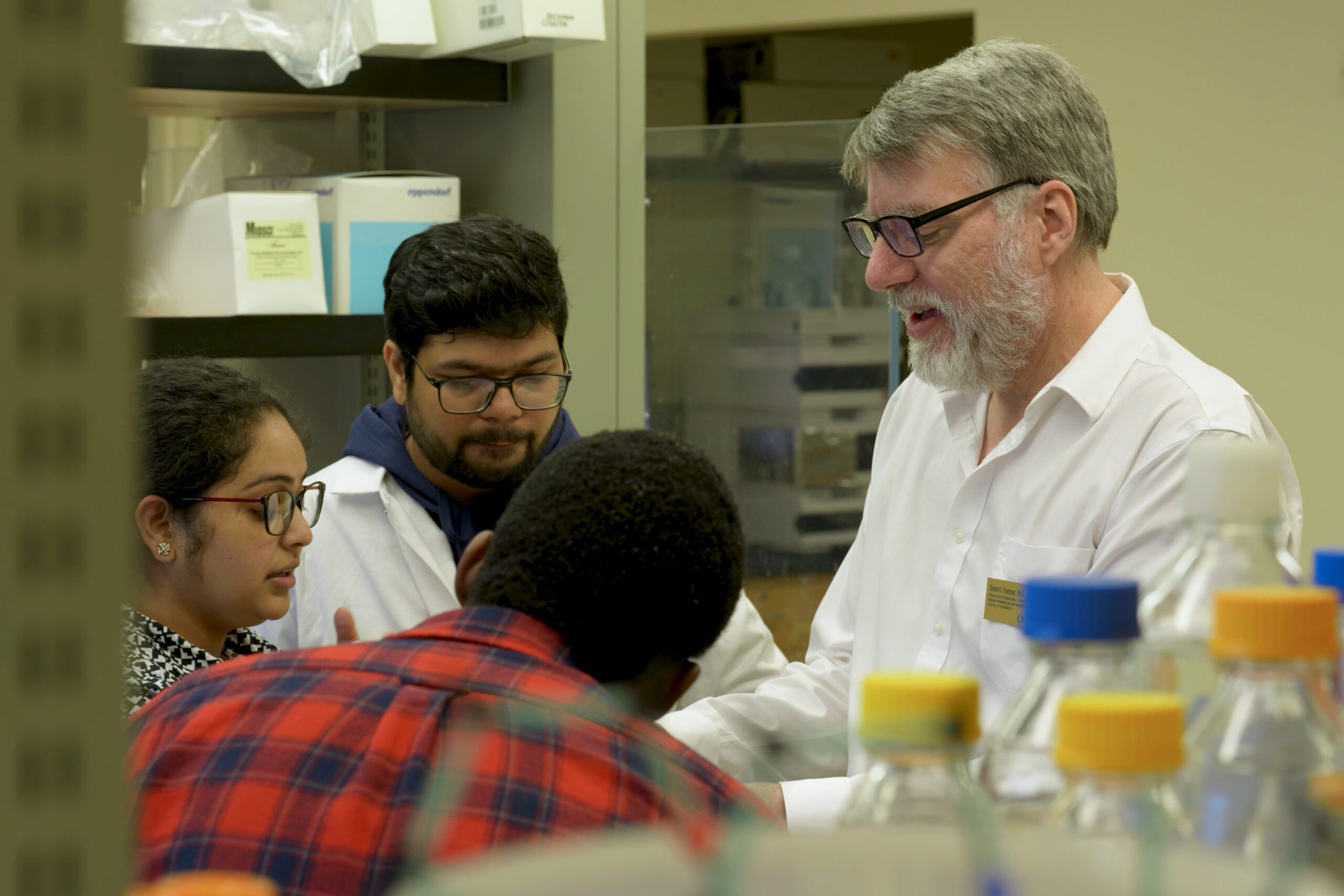
Chemist Brings Light to Diabetes Fight
Course 5 alum Simon Friedman '89 was recently featured on the MIT Alumni Association's Slice of MIT blog.
It’s amazing what a little light can do. Chemist Simon Friedman ’89 is using it in a system he hopes will help some of the 589 million people around the world who are living with diabetes.
Friedman, a Curators Distinguished Professor of pharmacology and pharmaceutical sciences at the University of Missouri, Kansas City, has led the work to develop materials that can hold a well of insulin under the skin until activated by light. This system allows controlled release of insulin without the risks associated with today’s mechanical pumps, which are susceptible to clogs and infection at the catheter site.

Problem-solving is a creative pursuit for Friedman, who first got interested in chemistry during high school in Chicago when he came across a book featuring illustrations of molecules. He says, “I remember just flipping through pages of these structures and thinking, ‘Who made these? How do you make these things? Why do these exist?’”
A chemistry major at MIT, Friedman landed a UROP in a lab as a sophomore. Over the next few years, he conducted hands-on research on anti-cataract compounds and earned multiple patents. “That was a life-changing experience,” he says. After a PhD in pharmaceutical chemistry from the University of California, San Francisco, and postdoctoral training at Caltech, he founded his current lab in 1999. There he began investigating molecules for targeting cancer, which led to his work with light-cleaved linkers—chemical bonds that can be broken with light.
As one thing led to another, Friedman began using light-cleaved linkers to modify gene-silencing molecules called small interfering RNA. Then, about a decade ago, he decided to apply what he’d learned to insulin delivery—which is challenging because the body’s need for the glucose-regulating hormone varies throughout the day. While insulin pumps can provide appropriate dosing, these external devices depend on keeping a connection into the body open.
Friedman’s system, known as a photoactivated depot (PAD), avoids that by binding insulin to another molecule using a light-cleaved linker. This makes it possible for insulin to stay inert under the skin until activated by the right wavelength of light from outside the body. The approach is supported by NIH and has been tested successfully in diabetic rats.
The PAD is not quite ready for human use—one remaining hurdle is releasing the amount of insulin people need—but tackling such challenges is what makes science fun, Friedman says: “I like solving problems and puzzles.”